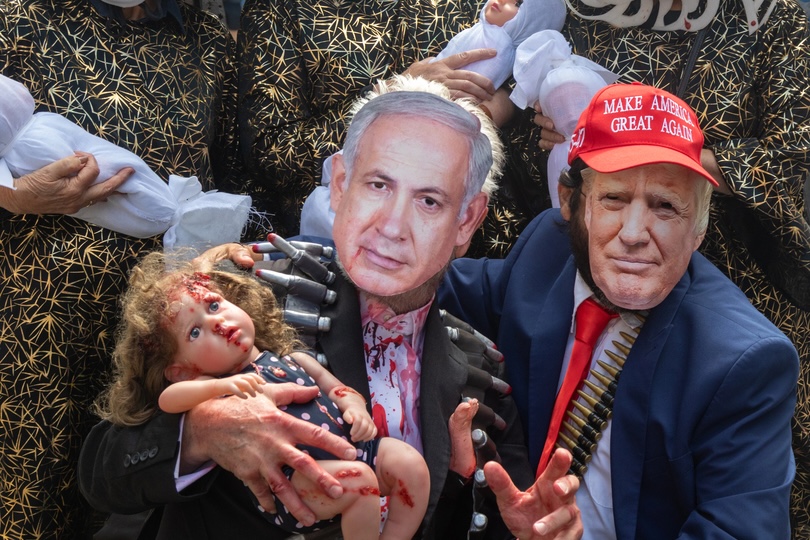
Anxiety over the existentially precarious position Israel occupies in the Middle East has persisted for thousands of years, though it has grown and intensified after World War II; genocide was no longer mere theory, it had been attempted. While existential anxiety can be alleviated, mitigated, and ultimately eliminated through dedication, discipline, and intentional action, Israel’s persists. Israeli and American politicians have personally found it politically useful to maintain and leverage the eschatological anxiety of the Jewish people. Existential angst matters here: in the spectrum of conflict, it escalates everything into an absolute position, one where defeat is untenable – because there will be no tomorrow (Speier 1941). When absolute anxiety extends beyond martial conflict and becomes internalized within any dispute or disagreement, it presents in one of two absolute or “fanatic” forms: zeal or spite (Oprisko 2010). Fanaticism generally is, “the political mobilization of the refusal to compromise” (Olson 2009, 83). Within that there is a characteristic of directionality between the self/in-group and the other/out-group; zeal is the absolute will to inflict one’s value system onto others whereas spite is the absolute rejection of others’ values being inscribed onto the self (Oprisko 2010).
Israel’s Precarity
In the case of Israel, the tangible history of existential cost has revealed itself into both fanatic forms, raising tension and “justifying” awful actions, “sticking to principle regardless of the consequences” and “too often willing to engage in morally dubious or even violent means to achieve its ends” (Olson 2012, 688). It is precisely because of Israel’s unique position as the ancestral homeland of the Jewish peoples combined with the historical experience of attempted genocide that presents validation to the absolute character of conflict (Oprisko 2011). This historical record is clear: Israel stands alone. This feeling feels true even if Israel is, in fact, surrounded by allies like the United States, most of Europe, India, and the Abraham Accord nations.
The fear of oblivion is so strong that support of Israel by citizens of allies (i.e., persons who don’t live in Israel and aren’t Jewish) represents a litmus test of the allies’ heads of government. For Israel, you are either with or against, a position of clarity in the sovereign decision on where to draw lines of exclusion and inclusion (Simmel 1964).
Difficulties in maintaining existential anxiety over extended periods of time are mixed. For some scholars, the absolute nature of the fear is such a driving force that their entire multi-generational career is defined by contemplation upon and persistent reconsideration of how the end times will happen (For a non-exhaustive list see: Beres 1977, 1980, 1985, 1986, 1987, 1989, 1989-1990, 1991-1992, 1993, 1995, 2002a, 2002b, 2014, 2016). Similarly, it is a rite of passage for American presidents to navigate the possibility of “Peace in the Middle East” (Nixon 1969; Ford 1975; Carter 1979; Reagan 1981; G.H.W. Bush 1991; Clinton 1998; G.W. Bush 2002; Obama 2012; Trump 2018b; Biden and Lapid 2022). Israel’s tenuous position is, in some ways, a cottage industry.
From Spite to Zeal
Given the deep and pervasive concern of annihilation, Israeli spite to withstand and reject external pressure elicits a sympathetic policy response from allies and reinforces the security protocols to reduce said anxiety. However, there has been an escalation in support from the allies that stand with Israel as Israel stands alone that has gradually transitioned a defensive stance into an offensive stance that justifies its position by equating the existence of others in the area as a clear and present danger to the existence of Israel. Escalation from anxiety is not new. An excellent parallel example is the historic Russian motivation for a warm water port, which Kerner positions as a “fundamental urge” (Kerner 1942). This urge transitioned from this single point of focus to the creation of satellite states to insulate it from invasion, a historical anxiety that persisted from the Golden Yoke to the Steel Curtain (Kennan 1947; Mearsheimer 2001).
American presidents and, therefore, the United States military, have long supported Israel. Beginning with Nixon, we see the agreement not to pressure Israel to sign the Non-proliferation Treaty or reduce its nuclear capabilities (Nixon 1969). Ford followed with a declaration that a weak Israel was an “existential threat” to the United States’ interests, followed by supplies of F-15 Eagles (Ford 1975). Carter reinforced Israel by agreeing to supply them with oil in an emergency as a means to reduce the impact of potential hostilities between Israel and oil rich neighbors (Carter 1979). The twist from support of defense to support of offense took place under Reagan; the UN Ambassador condemned Israel’s preemptive strike on the Osirak reactor facility, but President Reagan followed with tacit personal approval for the Begin Doctrine wherein Israel would never allow a nuclear or existential threat to mature (Reagan 1981). Bush incorporated the physical defense of Israel against Iraqi SCUD missiles using new Patriot missile defense systems as a specific inclusion in NSD-54 (G.H.W. Bush 1991). The final part of the pivot came with Clinton when he forced the Palestinian Liberation Organization to remove its charter calling for the destruction of Israel as part of the security-first framework in the Wye River Memorandum (Clinton 1998).
G. W. Bush shifted the joint security paradigm from “land for peace” to “regime change for security” and identified Iraq, Iran, and North Korea as a “grave and growing danger” in his “Axis of Evil” speech (G.W. Bush 2002). Obama clarified the American position on Iranian nuclear capability as, “understand that I do not have a policy of containment; I have a policy to prevent Iran from obtaining a nuclear weapon.” He explicitly acknowledged that for Israel, a nuclear Iran is “not just a challenge… it is an existential threat” (Obama 2012). This unequivocal stance directly led to the Joint Comprehensive Plan of Action in 2015, which Obama followed by stating Iran was aware of a binary choice between diplomacy and war. (JCPA Joint Comprehensive Plan of Action 2015; Obama 2015).
In Trump’s first term, he withdrew from the JCPOA to better align with Israel’s preferred Begin Doctrine (Trump 2018b). He deepened that alignment with NSPM-11 wherein the United States would actively deny nuclear and ICBM capabilities to Iran (Trump 2018a). This was followed by the Maximum Pressure campaign designed to neuter Iran and reduce its existence as an existential threat to Israel (Pompeo 2018). This recontextualized trust between the United States and Muslim nations of the Middle East. Trump’s reversal of the Iran Nuclear Deal made a pivot back to cooperative democracy under Biden illogical; US foreign policy was becoming schizophrenic administration by administration. Rather than reverse course, Biden further deepened the commitment with “all elements of national power”, effectively promising American Total War to support Israeli Absolute War while tacitly accepting that threat of force was the preferred form of diplomacy in the Middle East (Biden and Lapid 2022). Within sixty short years, the existential anxiety that Israel felt regarding the actions, antagonism, and incursions by agonic rivals in the region had become joint preemptive strikes, threats, sanctions, and a general “peace through superior firepower” with Israel as antagonist fully supported by American military hegemony.
From Zeal to Distraction
Israeli maintenance of existential anxiety has provided an affirmative defense against seemingly bad faith activities such as asymmetrical response, bombing civilian sites, maintaining nuclear capability, and resettlement of Palestinians (Cordesman 2008; Citino, Gil, and Norman 2023; UN Security Council 2025; Mills 2025). Israel has leveraged this defense to dominate regional agonic and instrumental fighting (Speier 1941, 451). Reliance upon their anxiety as a justification has been a strategic asset that has even provided justification for assassination as a preemptive-strike tool to place into the kit of Israeli self-defense (Beres 1991-1992, 2002b). This tool that has now been leveraged to the hilt with the systematic killing of Iranian leaders en masse (Goren and Sayeh 2026).
The joint US-Israeli preemptive attack upon Iran as a stated response to existential dread has been delivered under absolute terms and it is now the absolute character of that dread that rings hollow. Operation Epic Fury has shown an absolute character for Iran, but not for either Israel or the United States: Iran has absolutely no capacity for meaningful response. The absolute conviction to inflict Israel’s value system onto another (zeal) is being shown as the reality whereas the image of Israeli defiance against fear, terror, and existential anxiety (spite) is shown to be illusory, mere shadow puppetry once the lights turn on (Oprisko 2011). The world now can weigh the relative positions of Iran and Israel and to determine their respective differential insecurities ex post facto (Oprisko 2012).
Operation Epic Fury presents as a distraction, like theater. The plot is more fiction than fact, too farfetched to ring true – military attacks when diplomacy appears to be winning the day does not suggest imminent destruction (Hafezi and Le Poidevin 2026). Experience transcends gaslighting; Israel is capable of self-defense against Iran as a source of anxiety. In fact, they are capable of offense. More to the point, Iran is clearly not at the same level of military capacity, capability, or sophistication as Israel. In the absence of a defensible anxiety, the public must search for a rational justification because the official stories keep changing (Mulroy 2026). The “war” is not a war at all – Iran can’t fight back, they lost before they knew a fight was taking place. All that is left is the anxiety as distraction, a clearly untrue position from unreliable narrators that upends the calculus of acceptability in the international community.
Distraction’s point of origin is now the focus. Was Operation Epic Fury designed to distract the public from the Epstein File Releases? (Statement on the Production of Materials to the Epstein Files Transparency Act ; Epstein Files Transparency Act – Production of Department Materials 2026; “The Epstein Files: What We Know About His Links to Iran” 2026; Whitehead 2026). Was it designed to distract European Allies from the new Monroe Doctrine that it seemingly ignores? (Trump 2025). Is it designed to bolster support of AI in military operations? (Desmarais 2026).
From Distraction to Failure
The clear and undeniable success of the joint US-Israeli strikes against Iran do not simply mitigate the existential anxiety of the Jewish people and state, it utterly destroys the public façade maintaining that anxiety and eliminates the ideology as an aegis for any aggressive action taken (Oprisko 2015). Operation Epic Fury has been so successful so quickly, and the rationale for the aggression so flimsy that the world isn’t responding jingoistically, it’s attending a funeral; the world hasn’t seen such a lopsided win in an “even fight” since Ali-Liston II (Albanesi 2021). By having one-shot the end boss, the US and Israel have lost a value greater than any they will gain through success: an excuse for any bad behavior (Kain 2024).
Overwhelming military dominance should feel like success, but the end result is failure via strategic blunder: Israel has inadvertently killed the ‘golden goose’ of all defenses by exposing Iran as a hollow threat. Israel’s destruction of Iran is the act of a bully imposing will upon a weak and ineffective victim (Hoffman, Buck, and Thompson 2026). This asymmetrical outcome is an agential cut that illuminates the reality of Israeli supremacy – the assumption of regional hegemon – their position is indelibly altered and the reaction to their aggression must be viewed in new light (Oprisko 2014; Badiou 2005). Ayatollah Khamanei, half of the 86-member Assembly of Experts, and a “majority of Iran’s senior military leaders” have been assassinated in the initial strikes of Epic Fury (Edwards 2026). The US government has stated clearly that disruption of leadership, chaos, is the purpose (Stein 2026). Trump is openly stating he will (help) install the new leader as was true in Venezuela (Ravid and Basu 2026). He is also demanding unconditional surrender (Craw et al. 2026).
With the impenetrable defense not just penetrated, but shattered, the perception shifts: what were Trump and Netanyahu thinking? Iran is visibly not only not an existential threat to Israel, their power projection capability is shown to be impotent and that they are, and have been, a harmless paper tiger (Khatib 2026; Keating 2026). The Axis of Resistance’s collective ineffectiveness reinforces Israel’s dominant position in the region, placing it as predator, not prey (Frantzman 2025). The international public has been duped, potentially for decades. Why the fraud? (Oprisko 2013).
From Failure to Anxiety
The end result of Operation Epic Fury is a return to anxiety. Israel has demonstrated regional supremacy while the United States has effectively forgotten its allies in the two weeks following the security meetings in Brussels (Magdy, Price, and Madhani 2026; Mason, Crerar, and Topping 2026). Rubio confirmed that the United States joined the conflict to avoid the possibility of effective Iranian response given that Israel would attack unilaterally otherwise (Rubio 2026). Trump has stated displeasure of Israeli attacks on Iranian oil assets (Forster 2026). The tail is wagging the dog. Iran as source of Israeli existential dread, now visible as fraud, has been exchanged for a generalized global anxiety over the willingness of the US and Israel to use disproportional force response even when unprovoked. The world has become less certain and more dangerous.
Neither Trump nor Netanyahu are acting as if Iran were dangerous. The inauthenticity of this attack reminds us of domestic problems and concerns that remain despite the interruption. If this was truly designed as diversionary war, it failed because the threat didn’t survive long enough to capture the public attention. By destroying the fabricated, diversionary target so thoroughly in such a short span of time, with minimal effort, the diversion itself inverts and focuses the attention on why a diversion was necessary.
Levy’s seminal chapter on diversionary conflicts is interesting here because the present case provides the logical limits to their effectiveness. A stated threat that has no ability to pretend to put up a fight is not one that can be effectively leveraged as a diversion; the façade has to survive minimal scrutiny. Simply put: for a diversion to succeed, the threat must be viable. As Levy himself put it, “When decision-making elites perceive that their political authority is becoming increasingly tenuous, they are inclined to take particularly drastic measures to maintain control. The greater the internal threat, the less elites have to lose from risky measures and the more likely they are to gamble” (Levy 1989, 274). Some gamblers hide cards up their sleeves.
The illegitimate use of sovereign violence has been projected abroad to paper over legitimate responsibility to govern sovereign citizens, some of whom have now been killed for a failed hoodwink. The most salient lesson to carry from this farce is how to distinguish a good act from an evil act in practice: a good act is when a person sacrifices some or all of themselves for the benefit of others; an evil act is when a person sacrifices others for the benefit of themselves.
References
Albanesi, Melanie. 2021. Ali’s “Phantom Punch” Controversy Explained. Antiques Roadshow. Accessed March 9, 2026.
Badiou, Alain. 2005. Being and Event. Translated by Oliver Feltham. London, UK: Continuum.
Beres, Louis Rene. 1977. “International Terrorism and World Order: The Nuclear Threat.” Stanford Journal of International Studies 12: 131-146.
—. 1980. Apocalypse: Nuclear Catastrophe in World Politics. Chicago, IL: University of Chicago Press.
—. 1985. “Genocide.” Review of Policy Research 4 (3): 397-406.
—. 1986. Security of Armageddon: Israel’s Nuclear Strategy. Lexington, MA: Lexington Books.
—. 1987. “Genocide and Power Politics: The Individual and the State.” Bulletin of Peace Proposals 19 (1): 73-79.
—. 1989. “International Law, Personhood, and the Prevention of Genocide.” Loyola of Los Angeles International and Comparative Law Journal 11: 25-66.
—. 1989-1990. “Genocide, State, and Self.” Denver Journal of International Law and Policy 18 (1): 37-58.
—. 1991-1992. “On Assassination as Anticipatory Self-Defense: The Case of Israel.” Hofstra Law Review 20: 321-340.
—. 1993. “Preserving the Third Temple: Israel’s Right of Anticipatory Self-Defense Under International Law.” Vanderbilt Journal of Transnational Law 26: 111-148.
—. 1995. “Israel, the “Peace Process”, and Nuclear Terrorism: A Jurisprudential Perspective.” Loyola of Los Angeles International and Comparative Law Journal 18: 767-794.
—. 2002a. “Iraqi Crimes and International Law: The Imperative to Punish.” Denver Journal of International Law and Policy 21: 335-360.
—. 2002b. “The Newly Expanded American Doctrine of Preemption: Can it Include Assassination?” Denver Journal of International Law and Policy 31: 157-178.
—. 2014. “Like Two Scorpions in a Bottle: Could Israel and Nuclear Iran Coexist in the Middle East.” Israel Journal of Foreign Affairs 8 (1): 23-32.
—. 2016. Surviving Amid Chaos: Israel’s Nuclear Strategy. Lanham, MD: Rowman & Littlefield.
Biden, Joe R., and Y. Lapid. 2022. The Jerusalem U.S.-Israel Strategic Partnership Joint Declaration. edited by White House. Washington, DC.
Bush, George H. W. . 1991. National Security Directive 54: Responding to Iraqi Aggression in the Gulf. edited by White House. Washington, DC.
Bush, George W. 2002. Address Before a Joint Session of the Congress on the State of the Union. edited by U.S. Capitol. Washington, DC.
Carter, Jimmy. 1979. Memorandum of Agreement Between the Governments of Israel and the United States. edited by Department of State. Washington, DC.
Citino, Nathan, Ana Martin Gil, and Kelsey P. Norman. 2023. Generations of Palestinian Refugees Face Protracted Displacement and Dispossession. Migration Information Source. Accessed March 9, 2026.
Clinton, William J. 1998. The Wye River Memorandum. edited by Department of State. Washington, DC.
Cordesman, Anthony H. 2008. Arab-Israeli Military Forces in an Era of Asymmetric Wars. Stanford, CA: Stanford University Press.
Council, UN Security, July 16, 2025, 2025, “Killing of Civilians in Gaza Waiting in Line for Humanitarian Aid Must End, Relief Chief Tells Security Council, Urging Return to UN-Led Delivery Mechanism,” https://www.un.org/unispal/document/security-council-press-release-16jul25/.
Craw, Victoria, Lior Soroka, Mohamad El Chamaa, Suzan Haidamous, Heba Farouk Mahfouz, Siham Shamalakh, and Amy B. Wang. 2026. Trump Demands ‘Unconditional Surrender’ from Iran. The Washington Post.
Desmarais, Anna. 2026. AI on the Battlefield: How is the US Integrating AI into its Military? EuroNews.
Edwards, Christian. 2026. Who’s Running Iran Now that the Supreme Leader is Dead?
Epstein Files Transparency Act – Production of Department Materials. 2026. edited by U.S. Dept of Justice. Washington, DC: Office of Public Affairs.
“The Epstein Files: What We Know About His Links to Iran.” 2026. Iran International, February 4, 2026, 2026. https://www.iranintl.com/en/202602033927.
Ford, Gerald. 1975. Letter from President Ford to Prime Minister Rabin Regarding ‘Reassessment’ of U.S. Policy. edited by White House. Washington, DC: National Archives.
Forster, Erkki. 2026. Trump Blindsided by What’s Happening in His Own War. Daily Beast.
Frantzman, Seth J. 2025. Israel: Now the Dominant Military Power in the Middle East?
Goren, Aaron, and Janatan Sayeh. 2026. Israel Strikes Tehran Regime’s Assembly of Experts, Underlining Efforts to Disrupt Succession Process.
Hafezi, Parisa, and Olivia Le Poidevin. 2026. US-Iran Talks End with No Deal but Potential Signs of Progress. Reuters.
Hoffman, Jon, Brandan P. Buck, and Katherine Thompson. 2026. Cato Experts React to U.S. Attacks on Iran. Cato at Liberty.
Joint Comprehensive Plan of Action. 2015. edited by Department of State. Washington, DC.
Kain, Erik. 2024. Watch this ‘Elden Ring’ Player One-Shot Every Main Boss in the ‘Shadow of the Erdtree’ DLC. Forbes. Accessed March 9, 2026.
Keating, Joshua. 2026. Iran Had a Plan to Fight Israel and the US. It All Collapsed after October 7. Vox.
Kennan, G. F. . 1947. “The Sources of Soviet Conduct.” Foreign Affairs 25 (4): 566-582.
Kerner, R. J. 1942. The Urge to the Sea: The Course of Russian History, the Role of Rivers, Portages, Ostrogs, Monsteries, and Furs. Berkeley, CA: University of California Press.
Khatib, Lina. 2026. Iran is a Paper Tiger. Prospect.
Levy, Jack S. 1989. “The Diversionary Theory of War: A Critique.” In Handbook of War Studies, edited by Manus I. Midlarsky, 260-288. Boston, MA: Unwin Hyman.
Magdy, Samy, Michelle L. Price, and Aamer Madhani. 2026. Gulf Allies Complain US Didn’t Notify Them of Iran Attacks and Ignored Their Warnings, Sources Say. Associated Press.
Mason, Rowena, Pippa Crerar, and Alexandra Topping. 2026. US Did Not Share Details with the UK before Attacking Iran, Sources Say. The Guardian.
Mearsheimer, John J. 2001. “Victory and Survival.” In The Tragedy of Great Power Politics. New York, NY: W. W. Norton & Company.
Mills, Claire. 2025. Nuclear Weapons Profile: Israel. edited by House of Commons. London, UK: House of Commons Library.
Mulroy, Michael. 2026. US-Israel War on Iran: Former Pentagon Official Reveals Why the U.S. Says “We’re Not at War”. In Al Jazeera English, edited by Scott Heidler. Doha, Qatar: YouTube.
Nixon, Richard. 1969. Record of Conversation: President Nixon and Prime Minister Golda Meir. edited by National Security Administration. Washington, DC: National Security Archive (Declassified).
Obama, Barack H. 2012. Address to the American Israel Public Affairs Committee (AIPAC). edited by White House. Washington, DC.
—. 2015. Remarks by the President on the Iran Nuclear Agreement. edited by White House. Washington, DC: American University.
Olson, Joel. 2009. “Friends and Enemies, Slaves and Masters: Fanaticism, Wendell Phillips, and the Limits of Democratic Theory.” The Journal of Politics 71 (1): 82-95.
—. 2012. “The Freshness of Fanaticism: The Abolitionist Defense of Zealotry.” Perspectives on Politics 5 (4): 685-701.
Oprisko, Robert L. 2010. “Fanatic Zeal and Spite: Founding a Paradigm for Absolute Conflict.” Midwest Political Science Association, Chicago, IL, April 22, 2010.
—. 2011. “Israel’s Fanatic Duality: A Phenomenological Account of the Being in Multiplicity.” Midwest Political Science Association, Chicago, IL, 2011.
—. 2012. “The Differential Insecurity of Value: Honor Processes in International Status Quo Maintenance and Revision.” American Political Science Association, New Orleans, LA.
—. 2013. Egypt’s Three-Card Monte: The Arab Spring and Human Revolution. e-International Relations. Accessed 7/23/2013.
—. 2014. “Failure as the Real: A Review of Slavoj Zizek’s Less Than Nothing: Hegel and the Shadow of Dialectical Materialism.” Theoria & Praxis 1 (2): 1-4.
—. 2015. “Weinstein’s Methodology for Political Analysis.” In Michael A. Weinstein: Action, Contemplation, Vitalism, edited by Robert L. Oprisko and Diane Rubenstein, In Innovations in Political Theory, 139-147. New York, NY: Routledge.
Pompeo, M. R. 2018. After the Deal: A New Iran Strategy. edited by Department of State. Washington, DC: The Heritage Foundation.
Ravid, Barak, and Zachary Basu. 2026. Trump Says He Must Be Involved in Picking Iran’s Next Leader. Axios.
Reagan, Ronald. 1981. Statement on the Israeli Air Strike on Iraqi Nuclear Facilities. edited by White House. Washington, DC.
Rubio, Marco A. 2026. Secretary of State Marco Rubio Remarks to Press on Operation Epic Fury. edited by Department of State. Washington, DC.
Simmel, Georg. 1964. Conflict and the Web of Group-Affiliations. Translated by Kurt H. Wolff and Reinhard Bendix. New York, NY: The Free Press.
Speier, Hans. 1941. “The Social Types of War.” The American Journal of Sociology 46 (4): 445-454. http://www.jstor.org/stable/2769917.
Statement on the Production of Materials to the Epstein Files Transparency Act. edited by Department of Justice. Washington, DC.
Stein, Amichai. 2026. Iranian Regime Struggling to Organize Military Campaign, US-Israeli Officials Tell ‘Post’. The Jerusalem Post.
Trump, Donald J. 2018a. National Security Presidential Memorandum – 11. edited by White House. Washington, DC: Federal Register.
—. 2018b. Remarks by President Trump on the Joint Comprehensive Plan of Action. edited by White House. Washington, DC.
—. 2025. Presidential Message on the Anniversary of the Monroe Doctrine. edited by White House. Washington, DC.
Whitehead, James Francis. 2026. “Ex-Prince Andrew Arrested on Suspicion of Sharing Sensitive Documents with Epstein.” Courthouse News Service, February 19, 2026, 2026.
Further Reading on E-International Relations

