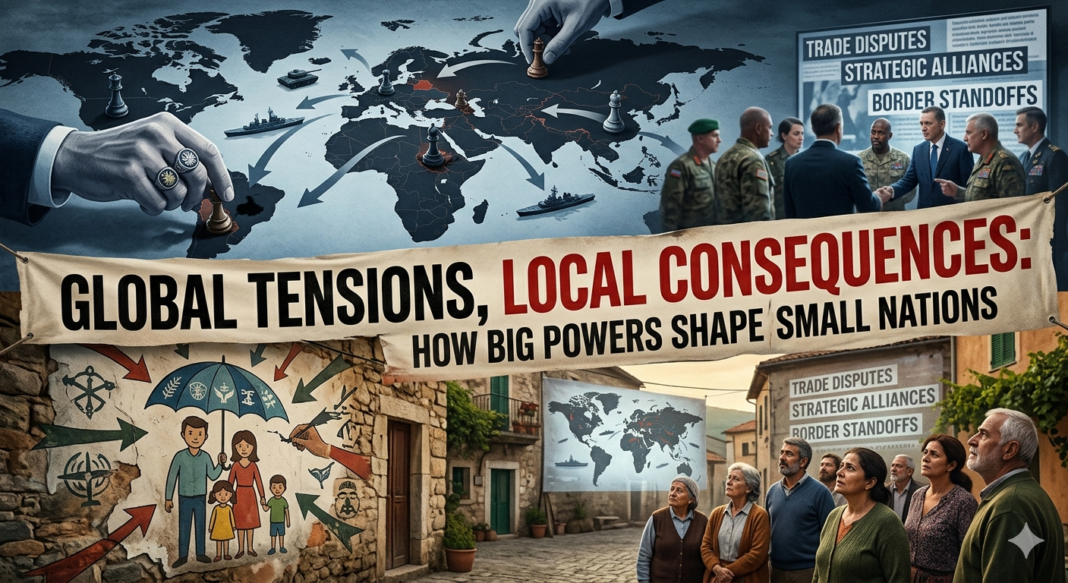
In today’s interconnected world, no nation exists in isolation. Decisions made in Washington, Beijing, Moscow, or Brussels rarely stay within those capitals. They travel through markets, alliances, conflicts, and ideas until they reach even the smallest and most distant countries. For small nations, global tensions are not abstract headlines; they are lived realities.
The Invisible Hand of Global Power
Major powers shape the international system through influence that is often subtle but deeply consequential. Economic policies, military alliances, sanctions, and diplomatic recognition all act as tools of control or persuasion.
When tensions rise between giants like United States and China, smaller nations feel the pressure to choose sides or risk being sidelined altogether. Trade routes shift, investments pause, and strategic partnerships become more conditional. In such an environment, neutrality becomes not just a policy, but a delicate balancing act.
Economic Shockwaves Without Warning
For small states, the global economy is both an opportunity and a vulnerability. A conflict far away can disrupt supply chains, increase fuel prices, and destabilize local markets overnight.
Consider how tensions in key maritime chokepoints like the Strait of Hormuz or the Bab el-Mandeb can affect countries that depend on imports. A spike in oil prices is not just a statistic it translates into higher transportation costs, rising food prices, and economic strain on ordinary citizens.
In many small nations, governments lack the financial buffers to absorb such shocks. As a result, global instability often becomes local hardship.
Security Pressures and Strategic Vulnerability
Security dynamics are another area where global tensions shape local realities. Competition between powerful nations frequently plays out in smaller regions, turning them into strategic arenas.
The Horn of Africa, for instance, has become a focal point for international interest. Countries like Somaliland sit at the crossroads of global trade and security routes, making them geopolitically significant despite limited recognition.
Foreign military bases, counterterrorism operations, and maritime security initiatives can bring both protection and pressure. While such involvement may enhance stability, it can also limit a nation’s autonomy and complicate its foreign policy choices.
Diplomatic Recognition: Power Beyond Legality
Recognition in international politics is not merely about meeting legal criteria it is about strategic interests. Small nations often find their diplomatic status influenced less by their internal achievements and more by external calculations.
For places like Somaliland, this reality is particularly clear. Despite maintaining relative stability and functional governance, its quest for international recognition remains shaped by broader geopolitical considerations. Major powers weigh regional alliances, security concerns, and political risks before making decisions that affect millions.
The Human Dimension of Global Politics
Behind every policy shift or geopolitical rivalry are ordinary people. When global tensions rise, it is often citizens in smaller nations who feel the consequences most directly.
- A farmer facing rising fuel costs
- A student dealing with limited opportunities
- A trader struggling with disrupted supply chains
These are not isolated experiences they are the human face of global politics.
Resilience and Strategic Adaptation
Yet small nations are not merely passive actors. Many have learned to navigate global tensions with creativity and resilience.
They diversify partnerships, invest in regional cooperation, and adopt flexible foreign policies. Some leverage their strategic locations, turning geography into an asset rather than a vulnerability.
In the Horn of Africa, the development of ports and trade corridors such as Berbera illustrates how small states can position themselves as indispensable players in global commerce.
Conclusion: A World of Shared Consequences
Global tensions will continue to define international relations, but their impact will never be evenly distributed. For small nations, the stakes are often higher, the margins for error narrower, and the consequences more immediate.
Understanding this reality is essential. Because in an interconnected world, stability is not just a privilege of the powerful it is a shared responsibility.
What happens between great powers does not stay between them. It echoes across borders, shaping lives, futures, and the fate of nations that may have little say in the decisions but must live with their consequences.
Mohamed Abdi Idris is a Somaliland-based analyst specializing in international relations, geopolitics, and foreign policy. He holds a Master’s degree in International Relations and Diplomacy and is actively engaged in policy discussions on global security, regional geopolitics, and the evolving strategic dynamics of the Middle East and the Horn of Africa. He is also involved in initiatives promoting peacebuilding, climate awareness, and international cooperation through civil society platforms in Somaliland.

