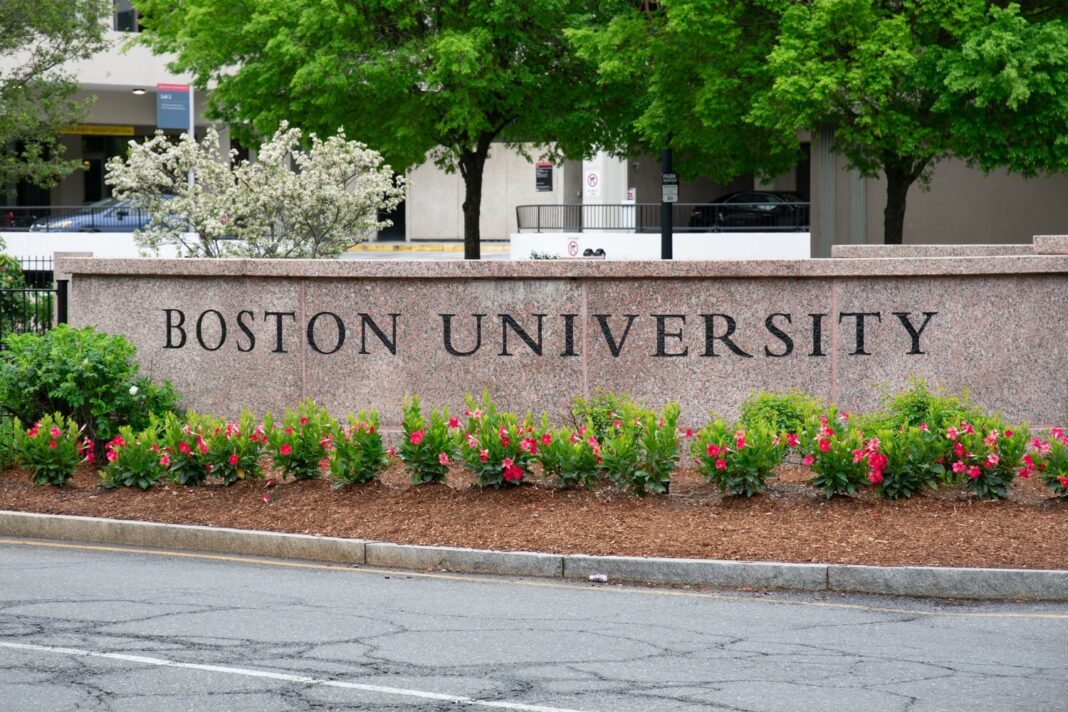
The Philippines could not stay out of a war over Taiwan, Renato Cruz De Castro, an international studies professor at De La Salle University, said at Boston University on Monday, arguing that geography has made the country’s alliance with the United States essential.
De Castro opened with a recent standoff. The Philippine Coast Guard apprehended a Chinese research ship conducting underwater surveys near Itbayat Island, the country’s northern most inhabited island located approximately 150 kilometers from the coast of Taiwan. The Chinese Embassy in Manila protested and said the waters were under Chinese jurisdiction, even though they lie far from China’s 10-dash-line. Taiwan then sent its own coast guard vessels to the area.
“Of course, China would often tell us Taiwan is an internal matter,” he said. “Well and good, but if you have a major conflict happening there, one way or the other we would be affected simply because of geography and given the fact that we have 250,000 Filipinos working in Taiwan as overseas workers.”
The talk — titled “The Philippine-U.S. Alliance in the Indo-Pacific: Implications for Taiwan” — was the first event in a series focused on Taiwan’s security presented by the BU Center for the Study of Asia’s Taiwan Studies Program. BU Professor of International Relations Min Ye moderated. Retired Vice Adm. Shoshana S. Chatfield, a former president of the U.S. Naval War College, served as commentator.
Like the U.S., the Philippines maintains a strict One-China policy, but De Castro said the standoff puts the country “in a dilemma wherein of course we have to interact with the Taiwanese.”
De Castro said Manila tried other approaches before turning to Washington. Decastro explained that, while Former President Rodrigo Duterte sought to appease Beijing, President Ferdinand Marcos Jr. initially hoped to balance between the two powers.
“Two years in the end of midterms, you basically realize whether you appease China or challenge China, you just get the same result: subjugation,” De Castro said.
Marcos instead adopted the Comprehensive Archipelagic Defense Concept, which De Castro called the country’s first grand strategy. The plan shifts the Philippine military’s focus from domestic insurgencies to external defense and builds up the country’s naval, air, and missile capabilities.
Get The Crimson in your inbox.
But De Castro said the strategy also accepts that the Philippines cannot match China’s military on its own.
“Alliance is a reality that we have to accept primarily given the geostrategic situation we’re facing,” De Castro said.
De Castro said the alliance has increasingly centered on northern Luzon, across the Luzon Strait from Taiwan. During this year’s Balikistan joint exercises, the U.S. and the Philippines staged their first maritime strike drills on Itbayat and moved U.S. missile launchers into the area.
Japanese ground troops also took part, which De Castro called a “historic break” for Japan.
Chatfield said the partnership benefits both militaries.
“This is a tremendous synergy and positive for both sides,” she said.
Ye said the series was designed to bring in speakers from a range of perspectives, because Taiwan’s security concerns extend well beyond the island.
“Taiwan security is not just about Taiwan security. It’s really broad Asia security, U.S.-China, Indo-Pacific. So it’s really global security,” Ye said.
Future events in the series will feature guests from Taiwan and a scholar of U.S.-Japan relations, according to Ye.
This event was co-sponsored by the BU Filipino Students Association and the BU Taiwanese Overseas Student Association, with support from the Republic of China’s Ministry of Education and the Taipei Economic and Cultural Office in Boston.

